Performance Anxiety in Young Athletes: How Parents and Coaches Make the Difference
The Most Common Challenge We See
If there's one challenge that brings families to sport psychology more than any other, it's performance anxiety. The young athlete who freezes in games. The one who gets sick before competitions. The one whose practice performance never shows up when it counts.
Performance anxiety in young athletes isn't rare — and it isn't a sign of weakness. It's a well-documented psychological response that has been studied extensively in sport psychology research, and the adults surrounding the athlete play a far bigger role in shaping it than most realize.
What the Research Shows About Anxiety and Performance
A meta-analysis by Woodman and Hardy (2003), published in the Journal of Sports Sciences, found that cognitive anxiety — the worry and self-doubt component of anxiety — has a negative relationship with sport performance [1]. But the relationship is more nuanced than "anxiety is bad."
The key insight from decades of research is that how anxiety is interpreted matters as much as the anxiety itself. Athletes who view pre-competition nerves as a sign of readiness tend to perform better than athletes who view the same feelings as a sign of impending failure [1].
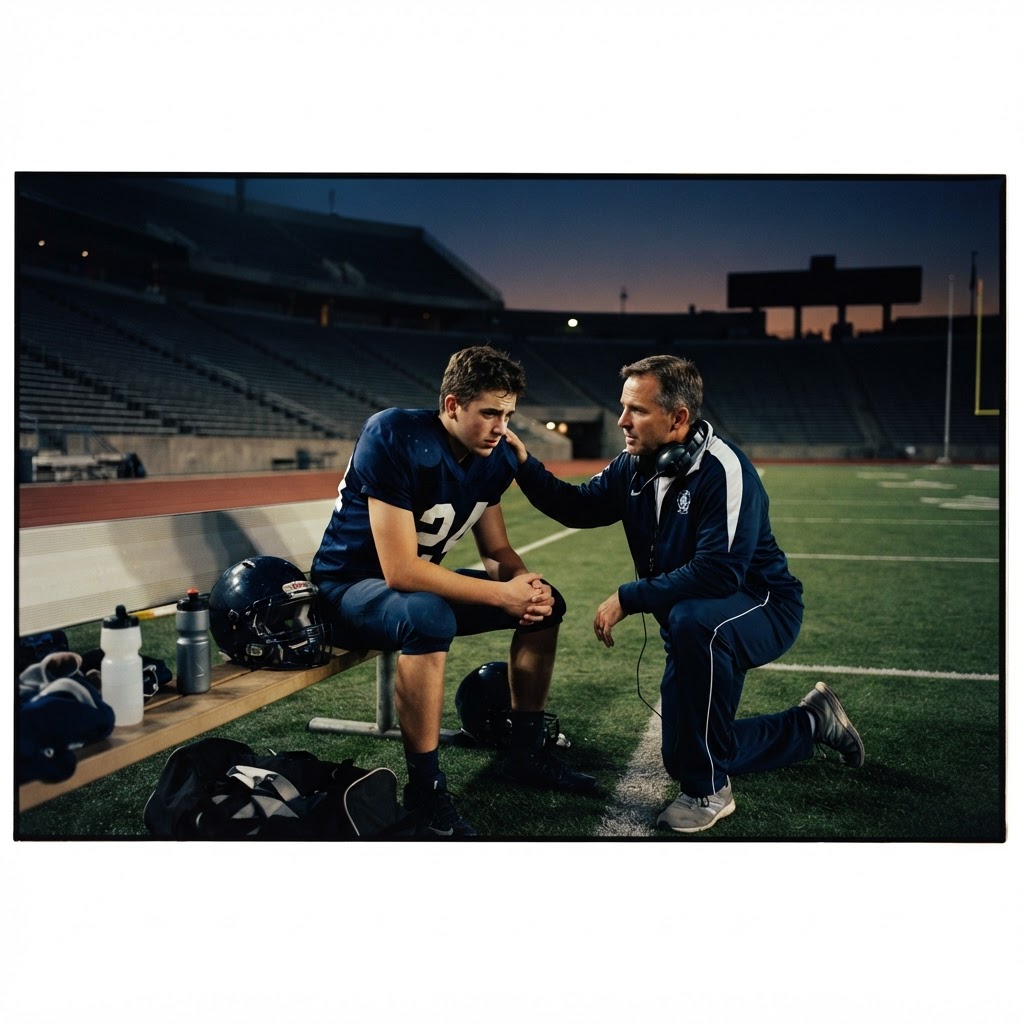
This is where parents and coaches come in. The messages adults send — before, during, and after competition — shape how young athletes interpret their own anxiety.
The Powerful Role of Coach and Parent Training
One of the most important studies in this area examined what happens when coaches and parents receive training in how to support young athletes. Published in the Journal of Youth Development, the study found that when coaches and parents were trained in supportive behaviors, young athletes' performance anxiety decreased significantly over the course of a season — while anxiety in the control group actually increased [2].
The study's multilevel analyses revealed that the training produced meaningful reductions in both somatic anxiety (the physical symptoms) and worry (the cognitive component) among young athletes in the experimental group [2].
This is a powerful finding: the adults' behavior, not the athletes' behavior, was the intervention — and it worked.
Parental Pressure: When Support Becomes Stress
Research also makes clear that parental involvement can cut both ways. A study published in the National Library of Medicine (PMC5613852) examining parental influence on youth athlete specialization found that parental pressure is linked to decreased enjoyment, burnout, and increased injury risk [3].
The distinction between supportive involvement and pressuring involvement is critical:
- Supportive involvement — attending games, showing interest, praising effort, respecting the athlete's autonomy
- Pressuring involvement — emphasizing outcomes, comparing to other athletes, tying love/approval to performance, pushing specialization
Research on trait anxiety in young athletes has found a positive relationship between parental pressure and anxiety levels — meaning that higher parental pressure is associated with higher anxiety in young athletes [4].
What the American Psychological Association Says
The American Psychological Association (APA) has highlighted the work of researchers Ronald Smith and Frank Smoll, who have conducted dozens of studies on coach-athlete relationships and youth sports. Their research consistently shows that a supportive coaching approach — one that emphasizes effort, mastery, and positive reinforcement — leads to better coach-athlete relationships, lower performance anxiety, and greater enjoyment for young athletes [5].
Smith and Smoll's research identifies specific coaching behaviors that reduce anxiety:
- Praise effort, not just outcomes
- Avoid ridicule and punishment for mistakes
- Focus on personal improvement rather than comparison to others
- Create a mastery-oriented climate rather than an ego-oriented one
Practical Takeaways for Parents and Coaches
-
Watch your post-game reactions. The car ride home is often the most stressful part of competition for young athletes. Ask "did you have fun?" before "did you win?"
-
Separate love from performance. Athletes need to know their value isn't tied to their stats. The research is clear that outcome-attached self-worth increases anxiety.
-
Model calm. Young athletes take emotional cues from the adults around them. A calm, grounded parent or coach helps the athlete stay calm.
-
Praise the process. Effort, preparation, and improvement are within the athlete's control. Outcomes often aren't.
-
Normalize nerves. Help athletes understand that pre-game anxiety is normal and can even be helpful — it means they care and their body is preparing for action.
-
Seek help when needed. If anxiety is causing physical symptoms, sleep problems, or making the athlete want to quit, a sport psychology professional can help.
At In the Zone Sport Psychology, we work with athletes, parents, and coaches across California to address performance anxiety using evidence-based approaches grounded in this research.
References
[1] Woodman, T., & Hardy, L. (2003). The relative impact of cognitive anxiety and self-confidence upon sport performance: A meta-analysis. Journal of Sports Sciences, 21(6), 443–457. https://doi.org/10.1080/0264041031000101809
[2] Effects of Coach and Parent Training on Performance Anxiety in Young Athletes: A Systemic Approach. Journal of Youth Development. https://jyd.pitt.edu/ojs/jyd/article/view/358/344
[3] Padaki, A. S., et al. (2017). Quantifying Parental Influence on Youth Athlete Specialization. National Library of Medicine (PMC5613852). https://pmc.ncbi.nlm.nih.gov/articles/PMC5613852/
[4] Trait Anxiety in Young Athletes as a Function of Parental Pressure and Motivational Climate. ResearchGate. https://www.researchgate.net/publication/233064904
[5] Put Me In, Coach: How to Spark Kids' Love of Sports. American Psychological Association (APA Monitor). https://www.apa.org/monitor/2016/11/kids-sports
Ready to Strengthen Your Athlete's Mental Game?
Connect with a sport psychology professional through secure virtual sessions.
Book a Consultation